The cost reason to avoid fine-tuning LLMs used to be real: training a 70B parameter model required a rack of H100s and weeks of compute budget. LoRA changed that. By training only a small set of adapter weights instead of the full model, LoRA makes fine-tuning accessible at a fraction of the original cost — and opens a path to replacing expensive frontier API calls with a purpose-built model that costs 50–200× less per token at inference time.
LoRA (Low-Rank Adaptation) was introduced by Microsoft researchers in 2021 (Hu et al., arxiv:2106.09685) and has since become the dominant parameter-efficient fine-tuning (PEFT) method in production. Its successor QLoRA pushed the memory envelope further, enabling fine-tuning of 65B+ parameter models on a single GPU.
Loupe by LeanLM (not affiliated with Google’s LearnLM educational AI) measures what AI workloads cost in energy per request — this post covers LoRA fine-tuning for cost-efficient task-specific models.
The business case: a LoRA-adapted Llama-3-8B for your specific task — customer support classification, document extraction, structured generation — can match frontier-model quality on that task while costing $0.20–0.40 per million tokens versus the $12–30 per million a 2026 frontier model charges for output. The adapter training is a one-time cost measured in hours; the inference savings compound daily.
LoRA is one technique in the broader enterprise LLM cost optimization toolkit. It pairs naturally with LLM model routing — only high-value queries hit the adapted model; everything else routes elsewhere.
Definition
LoRA (Low-Rank Adaptation) is a parameter-efficient fine-tuning technique that inserts trainable low-rank matrix pairs into frozen transformer layers. Instead of updating all model weights, LoRA trains only the adapter matrices — typically 0.1–1% of total parameters — while the base model weights remain unchanged. At inference, adapter weights are merged into the base model with zero latency overhead.
LoRA vs QLoRA vs Full Fine-Tuning: Cost Comparison
Here is how the three fine-tuning approaches compare on cost, GPU hours, and task-specific quality — the dimensions that determine which to choose:
| Approach | Cost per run | GPU hours | Params trained | vs Full FT quality | Best for |
|---|---|---|---|---|---|
| LoRA | $50–$500 | 1–6h | ~0.1–1% | ≈ Equivalent | 7B–13B models, GPU available |
| QLoRA (4-bit) | $3–$250 | 1–8h | ~0.1–1% | ≈ Equivalent | 33B–70B models, memory-constrained |
| Full fine-tuning | $2,000–$50,000 | 24–168h | 100% | Baseline | Broad capability shifts (rare in production) |
| No fine-tuning (API) | $0 training | — | — | Lower on narrow tasks | Low volume, early testing, general tasks |
Cost estimates based on RunPod A100 80GB SXM rates ($1.39 Community–$1.59 Secure) and Lambda's A100 80GB SXM rate ($2.79/hr, 8-GPU instance only) for a 7B model on 5,000–15,000 examples, as of September 27, 2026. 70B models run 5–10× higher. Quality comparisons per LoRA (Hu et al., 2021) and QLoRA (Dettmers et al., 2023) on domain adaptation benchmarks.
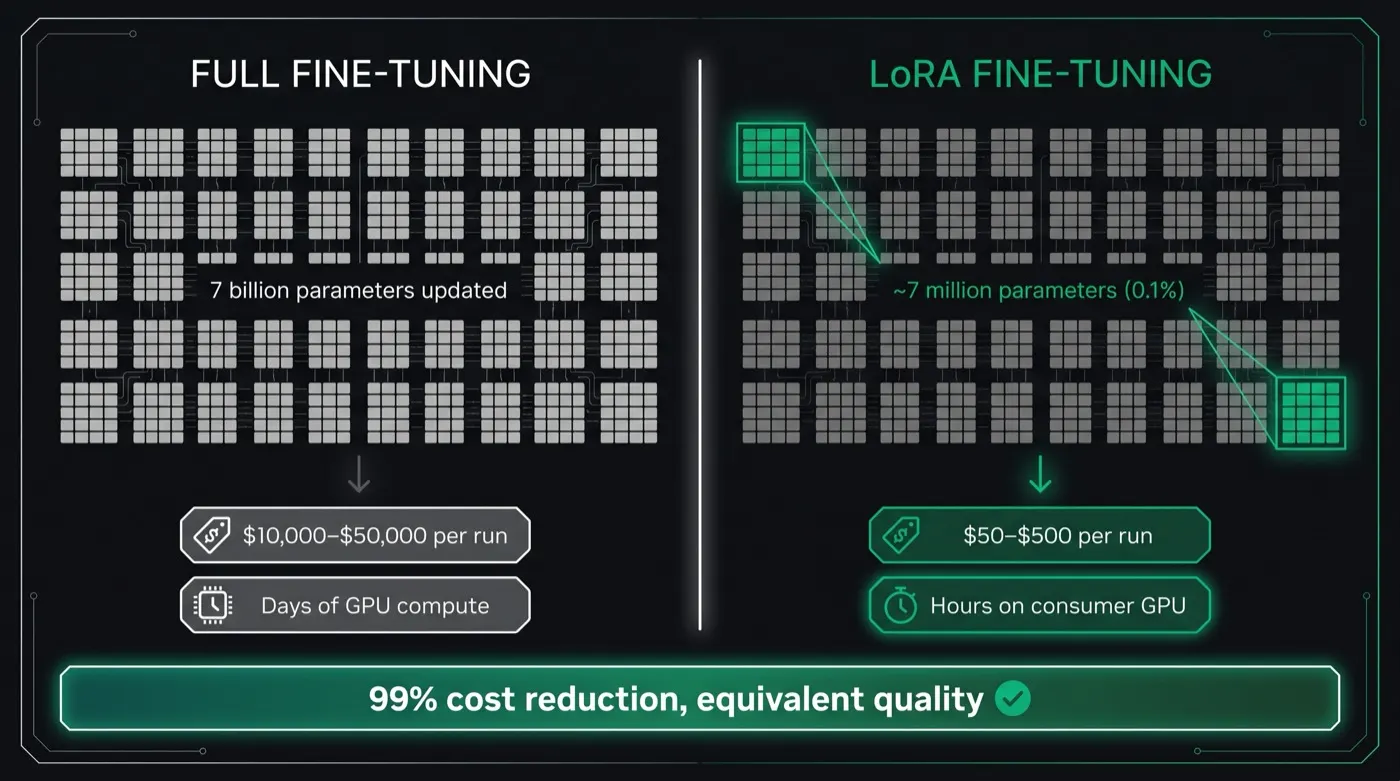
How LoRA Works
Standard fine-tuning updates all of a model's weights by backpropagating gradients through the entire parameter matrix. For a 70B parameter model, this means storing gradients for 70 billion floating point values — requiring hundreds of gigabytes of GPU memory just for the optimizer state.
LoRA's insight is that the weight changes needed for domain adaptation have a low intrinsic rank. You don't need to update the full weight matrix to specialize the model — you can approximate the update as the product of two small matrices.
Concretely: for a weight matrix W with shape [d, k], LoRA adds two adapter matrices A [d, r] and B [r, k], where r is the rank hyperparameter (typically 4–64). During training, only A and B are updated. The effective weight change is A × B, which has rank at most r. After training, the adapters can be merged: W_final = W + A × B. The merged model is identical to the original architecture — no adapter overhead at inference.
LoRA, QLoRA, and the PEFT Landscape
Standard Low-Rank Adaptation
Adds trainable adapter matrices (rank r) to attention and/or feed-forward layers. Base model loaded in 16-bit or 32-bit. Trainable parameters: ~0.1–1% of total. GPU memory requirement for 7B model: 14–20GB (2× A10G or 1× A100 40GB).
Best for: medium-size models (7B–13B), highest training quality, when GPU memory is not the constraint.
Hu et al. (Microsoft, 2021): LoRA matched or exceeded full fine-tuning on GLUE (RoBERTa/DeBERTa), E2E NLG (GPT-2 medium/large), and WikiSQL, MNLI-matched, and SAMSum (GPT-3 175B), with as little as 0.01% of trainable parameters. arxiv:2106.09685 ↗
Quantized LoRA (4-bit base)
Base model loaded in 4-bit NF4 quantization, reducing memory by ~75%. LoRA adapters trained in 16-bit bfloat16. Enables fine-tuning of 65B+ models on a single 48GB GPU. Training is slightly slower (~30%) than standard LoRA due to quantization overhead.
Best for: large models (33B–70B), memory-constrained environments, cost-optimized training pipelines.
Dettmers et al. (University of Washington, 2023): QLoRA matches 16-bit full fine-tuning on Vicuna benchmark. Guanaco-65B trained on single 48GB GPU in 24h. arxiv:2305.14314 ↗
Weight-Decomposed Low-Rank Adaptation
Extends LoRA by decomposing the pretrained weight into magnitude and direction components, then fine-tuning both separately. Achieves better task alignment than LoRA at the same parameter budget, particularly for tasks requiring significant behavioral shift from the base model.
Best for: tasks where standard LoRA leaves a noticeable quality gap, style adaptation tasks, and instruction following.
Liu et al. (NVIDIA, 2024): DoRA outperforms LoRA on commonsense reasoning, visual instruction tuning, and image/video-text understanding. arxiv:2402.09353 ↗
The Economics: When Fine-Tuning Beats API Calls
LoRA fine-tuning is not always the right choice. The economics depend on your query volume, task complexity, and quality requirements. Here is how to evaluate it:
Fine-tuning makes economic sense when:
- You have a single well-defined task type running at high volume (10,000+ calls/day)
- The task is learnable from examples — there is a consistent correct output for each input type
- You can build a reliable evaluation set to measure quality before deployment
- The task does not require frequently updated factual knowledge (which favors RAG)
Fine-tuning doesn't make sense when:
- Volume is low — training cost amortization requires sufficient query volume
- Task variety is high — a general assistant can't be specialized with a single adapter
- Knowledge freshness is critical — adapters don't update the model's knowledge cutoff
- You can solve it with prompt engineering — don't train a model to follow an instruction it already understands
A rough rule of thumb: if you're spending more than $5,000/month on API calls for a specific, repetitive task type, LoRA fine-tuning of an open-source base model will likely pay back its training cost within 30–60 days. Below that threshold, prompt compression typically delivers better ROI per engineering hour — no training infrastructure required.
Production Case Studies
Research Foundations
Practical Guide: LoRA Fine-Tuning on a Budget
The following workflow gets a LoRA-adapted model from zero to production in under a week, using cloud GPU rentals rather than owned infrastructure:
- Choose your base model — as of mid-2026, Qwen3-family models (the current Hugging Face derivative leader), gpt-oss, and the Llama 4 / Llama-3 line are the most commonly used open-source bases for domain adaptation. Use 8B unless your eval shows it underperforms. Larger models have diminishing returns for narrow task types.
- Prepare training data — 500 examples is enough for simple classification. 2,000–5,000 examples for structured extraction. 10,000+ for complex generation tasks. Format matters: use instruction-following format (system + user + assistant turns). Before you scale the set, check what the base model already gets right: in one 7B coding run, a 102-sample failure-only coreset trained in 2.39 minutes, while 292 of the 343 candidate tasks were already solved on the first attempt and only added noise.
- Build your eval set before training — 200–500 held-out examples with clear correct outputs. Define your quality metric (exact match, F1, human rating) before you see training results, to prevent eval overfitting.
- Train with QLoRA on cloud GPUs — as of September 27, 2026, RunPod prices A100 80GB SXM at $1.39–$1.59/hr and Lambda at $2.79/hr (8-GPU instance only). A 7B model on 5,000 examples trains in 1–3 hours ($1.39–$8.37). Use HuggingFace PEFT + TRL with default QLoRA config as starting point.
- Merge and serve — merge LoRA adapters into the base model (zero inference overhead), deploy via vLLM or Ollama. Benchmark latency and throughput against your SLA before switching traffic.
"The model doesn't need to be smarter than GPT-5.5 in general. It needs to be accurate on your specific task. LoRA fine-tuning lets you build exactly that — a 7B model that outperforms a 70B frontier model on the narrow task you actually need it for."
Frequently Asked Questions
What is LoRA fine-tuning?
LoRA (Low-Rank Adaptation) is a fine-tuning technique that trains small adapter matrices instead of updating the full model weights. Rather than modifying billions of parameters, LoRA adds pairs of small low-rank matrices to specific layers and trains only those — typically 0.1–1% of total parameter count. The base model weights stay frozen.
How much cheaper is LoRA than full fine-tuning?
LoRA reduces trainable parameters by 99%+ compared to full fine-tuning, directly reducing GPU memory and compute requirements. Fine-tuning Llama-3-70B with full fine-tuning requires 8× A100 80GB GPUs. LoRA fine-tuning of the same model can run on 2× A100s. QLoRA can run on a single A100. Training cost differences are proportional to hardware requirements.
What is QLoRA?
QLoRA (Dettmers et al., 2023) combines 4-bit quantization of the base model with LoRA adapters. The base model is loaded in 4-bit NF4 format, reducing memory by ~75%, while LoRA adapters are trained in 16-bit. QLoRA makes it possible to fine-tune 65B+ parameter models on a single 48GB GPU.
How do LoRA adapters reduce LLM API costs?
LoRA lets you replace expensive frontier model API calls with a self-hosted smaller model fine-tuned for your specific task. A LoRA-adapted 8B model for your use case can match frontier-model quality on that task while costing 50–200× less per token at inference time. The LoRA training is a one-time cost; the inference savings are ongoing — though running that model yourself only pays off if you keep the GPU busy, which is the heart of the self-host vs API cost decision.
Does LoRA match full fine-tuning quality?
On most task-specific fine-tuning benchmarks, LoRA matches full fine-tuning quality within 1–2% with a fraction of the compute. The original LoRA paper (Hu et al., 2021) showed this across RoBERTa/DeBERTa on GLUE, GPT-2 on E2E NLG, and GPT-3 175B on WikiSQL, MNLI-matched, and SAMSum. Quality gap appears on tasks that require broad model-wide representation changes — which is rare in production domain adaptation.
When should you use LoRA vs. other fine-tuning methods?
Use LoRA when: you need a domain-adapted model for a specific task type, you have 500–50,000 training examples, and your task has clear correct/incorrect outputs measurable by automated eval. Consider full fine-tuning only if LoRA quality falls short after hyperparameter tuning — which is uncommon in practice. Use prompt engineering or RAG instead of fine-tuning when your task requires frequently updated knowledge.