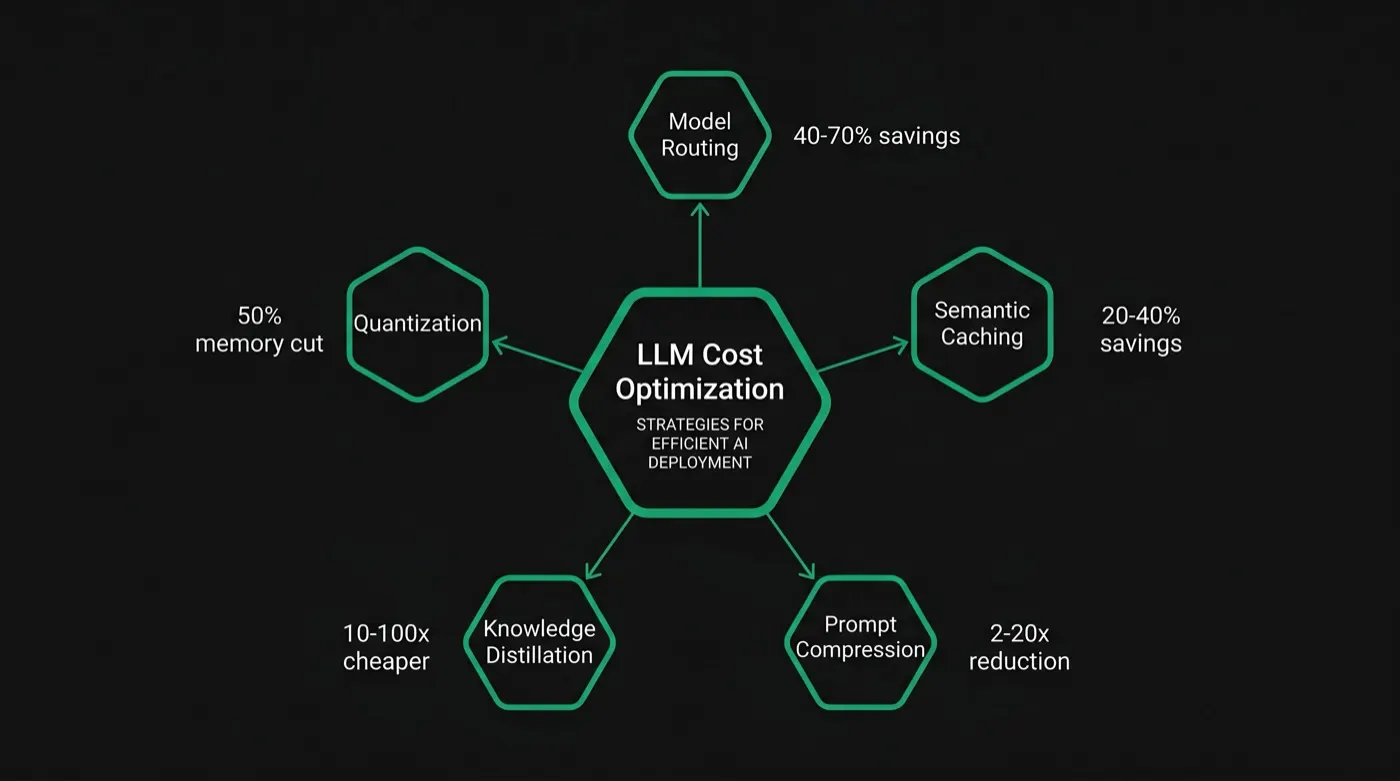
LLM costs can be reduced 50–90% using five techniques — model routing, semantic caching, knowledge distillation, prompt compression, and quantization — without rewriting your application or accepting quality tradeoffs. Most enterprise AI spend goes to frontier models on tasks where a cheaper model produces identical results.
Engineering teams ship fast by reaching for their most capable model: GPT-5.5, Claude Opus 4.8, Gemini 3.1 Pro. The first call works. The pattern sticks. Six months later, you're routing classification tasks, simple summarizations, and JSON extraction through a frontier model that costs $15 per million output tokens — when a purpose-built alternative would cost $0.40/M and produce identical results on your specific workload.
Loupe by LeanLM (not affiliated with Google’s LearnLM educational AI) measures what AI workloads cost in energy per request — this guide covers enterprise LLM cost optimization end to end.
Research puts the waste at 50–90% of total inference spend (Chen et al., Stanford — FrugalGPT, 2023). This article explains why it happens, what the academic literature says about fixing it, and how each technique stacks up in production.
Definition
LLM cost optimization is the practice of reducing AI inference expenditure without degrading output quality. It encompasses model routing (directing each query to the cheapest capable model), semantic caching (reusing prior responses for similar queries), knowledge distillation (training compact task-specific models), prompt compression (reducing token count), and quantization (reducing model weight precision). The goal is to pay for the intelligence each task actually requires — not the maximum available.
How to Reduce LLM Costs
To reduce LLM costs without sacrificing quality, apply these five techniques:
- Model routing — Direct each query to the cheapest model capable of handling it, informed by small language model vs LLM, measured on the same tasks. Saves 40–70% on high-volume pipelines. (Routing deep dive →)
- Semantic caching — Reuse responses for semantically equivalent queries. Cuts API calls 40–70% on repetitive workloads with near-duplicate queries. (Semantic caching deep dive →)
- Prompt compression — Remove redundant tokens from system prompts and user inputs before they reach the model. Achieves 2–20× compression with under 2% quality degradation. (Compression deep dive →)
- Knowledge distillation — Train a compact model on your specific task distribution using a leading model as teacher. Highest ROI for stable, high-volume tasks. (LoRA fine-tuning deep dive →)
- Quantization — Reduce model weight precision for self-hosting deployments. Cuts memory and compute without retraining, making self-hosting of large open-source models practical at lower hardware cost. (KV-cache deep dive →)
One sequencing note before the techniques: the cheapest first move for most teams is provider prompt caching — roughly 90% off a stable prompt prefix with zero quality risk — followed by the Batch API for latency-tolerant work. Start there, then layer the five structural techniques above; the full order-of-risk playbook is in the high-volume section.
Applied together, these techniques reduce enterprise LLM spend by 50–90% in production. The sections below explain the problem in depth, cover each technique with the supporting research, and compare tools.
The Overspending Problem
Most engineering teams don't choose their LLM based on task requirements. They choose it based on what they're already using. The path of least resistance is to use one model for everything — whatever produces the best output on the hardest task in the pipeline gets used on all tasks.
This creates a structural overspend problem. Consider a typical enterprise AI pipeline:
- Intent classification — determine what the user wants (binary or N-way classification)
- Entity extraction — pull structured fields from unstructured text
- Document summarization — condense long documents to key points
- Response generation — produce the final user-facing output
The first three tasks don't need a frontier model. A 7B or 13B fine-tuned model handles them at equal quality on most workloads — for 25–100x less per token. Only the last task, where quality variance matters most to users, benefits from frontier intelligence. On code, the cheaper lever may sit outside the weights: a stock 7B coding model with a test-feedback retry ladder passed 87.8% of HumanEval+ on one 32GB GPU, and no fine-tune we ran beat it on the blind score. That raises the question of when LLM self-correction is worth the tokens: our matched-budget test found blind retries match feedback repair at 24% fewer tokens.
Routing every call through a single top-tier model means paying top-tier prices for commodity inference. That's the waste.
The scale of the problem is now substantial. Enterprise LLM API spending doubled in six months — from $3.5B in late 2024 to $8.4B by mid-2025, per Menlo Ventures' 2025 Mid-Year LLM Market Update. Forty percent of enterprises now spend over $250K annually on LLMs. And research shows 60–80% of those costs come from just 20–30% of use cases — concentrated in high-volume, low-complexity tasks a purpose-built model could handle identically.
Why Engineers Default to Frontier Models
The overspend isn't irrational. There are real reasons teams don't optimize proactively:
Evaluation is hard. To know whether a smaller model is "good enough," you need to know what "good enough" means for each task — which requires building evals, collecting representative data, and running comparisons. Most teams skip this because it's engineering overhead that doesn't ship product features.
The cost is invisible until it isn't. At early scale, LLM spend is negligible. The problem becomes visible when you're at $10K/month, and by then the patterns are established and hard to change without touching production code.
Risk asymmetry. A quality regression caused by switching models is visible and blamed on the engineer who made the change. A 3x higher-than-necessary cost is invisible and blamed on "AI being expensive." The incentives favor over-modeling.
"Teams don't pay frontier prices because they need frontier quality on every call. They pay frontier prices because figuring out what each call actually needs is expensive — until someone automates it."
What's New in LLM Cost Optimization (2026 Updates)
The techniques above are stable; the price landscape they operate on is not. Four 2026 shifts change where the savings are (current lineup as of September 27, 2026):
- The frontier tier reset, twice over. OpenAI's gpt-6-astra/gpt-6-sol/gpt-6-luna, Anthropic's Claude Fable 5.1/Opus 5.5/Sonnet 5, and Gemini 3.1 Pro ($2/$12) are the current lineup; GPT-5.5 ($5 in / $30 out), Claude Opus 4.8 ($5/$25), and Sonnet 4.6 ($3/$15) are now previous-generation options still on the price lists. gpt-6-astra's $50/M output costs 100× gpt-6-luna's ($0.50/M). The bigger the spread, the more model routing pays.
- Cached-input pricing is now table stakes, and OpenAI's cache writes aren't free anymore. Every major provider sells cached input at ~90% off list (e.g. gpt-6-sol cached input $0.20/M vs $2.00), which makes prompt caching the highest-leverage zero-risk optimization for chat and agent workloads. GPT-5.6 and later, including the GPT-6 family, now charge 1.25× the input rate to write a cache entry, still net-positive after a couple of hits, but no longer the free write Anthropic-style caching implies.
- Reasoning tokens are a new line item. Reasoning-mode models bill their hidden thinking tokens as output — often the majority of the bill. Budgeting and capping them is a 2026-specific technique; see reasoning token costs.
- Effective cost ≠ list price. With caching, batch discounts, and reasoning overhead, ranking models by list price is misleading — our effective cost leaderboard re-ranks the current models by what workloads actually pay.
Understanding LLM Token Costs
Most LLM providers charge separately for input tokens (your system prompt, conversation history, and user message) and output tokens (everything the model generates). Output tokens typically cost 3–5× more than input tokens at equivalent model tiers — so verbose system prompts and long context windows compound quickly as call volume scales. See what one LLM request actually costs in dollars and joules on measured workloads, or estimate your monthly LLM API spend for any input/output mix and call volume before committing to a model.
Understanding this structure reveals where model selection has the most leverage over LLM costs — per-task pricing spreads widely across providers, which is why our ranking of the cheapest LLM APIs by effective cost re-scores the list on real workload mixes rather than headline rates. Classification and extraction tasks carry large input token counts but generate short outputs; response generation and summarization accumulate output token costs. Prompt compression targets input tokens directly; caching eliminates API calls for both; routing directs each query to the model where per-token pricing is lowest for that task's complexity. For teams self-hosting open-source models, per-token pricing disappears entirely — replaced by fixed compute costs that don't scale with volume, though whether self-hosting an LLM is actually cheaper than the API comes down to how busy you keep the GPU.
Tracking cache hit rates alongside LLM costs per call surfaces the real unit economics. When expensive models handle queries that a purpose-built alternative could match at the same quality threshold, the gap is where the optimization opportunity lives. Dedicated LLM cost tracking tools make this visibility continuous rather than a one-off audit.
How to Reduce Inference Costs for a High-Volume LLM Application
To reduce inference costs for a high-volume LLM application, apply the levers in ascending order of risk: cache the repeated prompt prefix (~90% off those input tokens), batch anything that tolerates delay (~50% off input and output), route the predictable share of traffic to a smaller model, and only then evaluate self-hosting. At high volume these levers compound — caching plus batching and routing typically remove 70–80% of the bill without changing a single response.
Before evaluating self-hosting at this stage, check how much VRAM a local LLM needs at the model size your predictable-traffic share would run on, and if that traffic includes coding tasks, see which local coding model to run on the same hardware.
What makes high volume different is not the technique list — it's that fixed-cost levers finally amortize. Below roughly one request per second, the engineering time to build a routing layer costs more than it saves. Above it, the same routing layer pays for itself weekly, cache hit rates climb as prompt prefixes repeat, and provider discount tiers (batch, committed throughput) become reachable. The table below shows where each lever starts paying.
| Lever | Starts paying at | What it requires | Typical effect |
|---|---|---|---|
| Prompt caching | Any stable system prompt, from the first repeated call | A fixed prompt prefix that doesn't change per request | ~90% off the cached input tokens |
| Batch API | Any workload that tolerates hours of latency | Non-interactive path (backfills, enrichment, evals) | ~50% off both input and output |
| Model routing | Mixed query complexity at sustained volume | An eval set from your own traffic + a threshold | 40–70% on the routed share |
| Semantic caching | Near-duplicate query rate above ~30% | Embedding index and a similarity threshold | 40–70% fewer API calls |
| Committed throughput | Predictable, sustained QPS | Forecastable load and a provider commitment | Negotiated rate plus a latency floor |
| Self-hosting | Roughly $5–10K/month of frontier spend, or 2–5M tokens/day | GPU operations capability and high sustained utilization | Fixed cost replaces per-token cost |
Thresholds are order-of-magnitude guidance for 2026 pricing, not hard cutoffs — the break-even for each lever depends on your prompt shape, latency budget, and how busy you keep the hardware. See self-hosting LLM cost for the utilization math behind the last row.
Worked example: 1 million requests per day
Take a support-ticket triage pipeline running 1,000,000 requests/day, averaging 1,200 input tokens (a 1,000-token system prompt plus a ~200-token ticket) and 150 output tokens, all sent to a frontier model. Using list prices as of July 2026 (gpt-5.5 at $5.00/M input, $30.00/M output; gpt-5.4-mini at $0.75/M input, $4.50/M output; cached input at 90% off for both), the stack looks like this:
| Configuration | Input cost/day | Output cost/day | Total/day | Monthly (30d) |
|---|---|---|---|---|
| Everything on gpt-5.5, no caching | $6,000 | $4,500 | $10,500 | $315,000 |
| + prompt caching on the 1,000-token prefix | $1,500 | $4,500 | $6,000 | $180,000 |
| + route 70% of tickets to gpt-5.4-mini | $607.50 | $1,822.50 | $2,430 | $72,900 |
Arithmetic: caching drops input from 1,200 billed tokens/request to 200 uncached (at $5.00/M) plus 1,000 cached (at $0.50/M). Routing then moves 700,000 requests/day to gpt-5.4-mini, where the same shape costs $630/day versus $1,800/day for the 300,000 left on gpt-5.5. Net: 77% lower spend, roughly $242,000/month saved, with output quality unchanged on the routed share provided it passes evaluation. Prices as of July 2026 — see the effective cost leaderboard for the current per-model figures, including batch and cache-stacked rates.
Two things about that example generalize. First, the biggest single line item is output tokens on the frontier model — which is why routing the high-volume, short-output tasks matters more than shaving input. Second, none of the savings above required a quality tradeoff: caching is bit-identical, and the routed share only moves once it passes evaluation on your own traffic. The order matters too — cache first (zero risk), batch second (latency only), route third (needs validation), self-host last (needs operations).
Run the same math on your workload
Monthly (30-day) estimates at list prices as of September 27, 2026; the worked example above uses the July 2026 lineup, which the "previous gen" options reproduce. For batch rates, reasoning tokens, and more models, use the full LLM cost calculator — or follow the measurements and LeanLM runs this analysis on your live traffic.
Enterprise LLM Cost Optimization: What Changes at Scale
For enterprises that need to optimize LLM spend without sacrificing output quality, the answer is per-task evaluation, per-team cost attribution, and validated model swaps — delivered either through an optimization platform (LeanLM, LiteLLM, Portkey) or an in-house evaluation suite. The techniques match startup-scale optimization; what changes is that governance, procurement, and attribution decide whether the savings actually get captured.
Enterprise LLM optimization is a different problem than startup optimization — same techniques, different constraints. At a 50-person startup, an engineer can swap a model on Friday and observe the impact in production by Monday. At a 5,000-person company with established procurement, security review, compliance boundaries, and multi-team cost attribution, that same swap becomes a 6-week project. The optimization opportunity is larger; every hour of unaddressed waste is correspondingly more expensive.
Three dynamics make enterprise LLM deployment costs distinct:
Vendor lock-in compounds the overspend. Enterprise procurement is sticky. Once Azure OpenAI or AWS Bedrock is approved, the path of least resistance is to keep using the same GPT-5-class endpoint across every team — even when a different provider's smaller model would work identically for a specific workload. The cost of re-running security review for a new vendor often exceeds the perceived savings, so teams over-model rather than re-procure.
Multi-team token allocation hides the problem. When LLM spend is billed to a central platform team, individual product teams don't see the unit economics of their own calls. A team optimizing for shipping speed reaches for the most capable model on every task because they're not paying the cost in their own budget. Enterprise LLM cost management requires per-team or per-feature attribution before optimization decisions become rational.
Governance overhead favors over-modeling. Enterprise AI deployments require model cards, evaluation reports, bias audits, and compliance documentation for each approved model. The fixed cost of qualifying a model is high enough that teams default to the most capable option to avoid re-qualifying a smaller one later. The asymmetry compounds: a quality issue from a smaller model triggers an incident postmortem; a 3× higher-than-necessary inference cost rolls into the platform team's budget and stays invisible for months.
The fix is not to bypass these dynamics — they exist for legitimate reasons. The fix is to bring the same governance rigor to cost as enterprises already apply to security and quality: per-task model evaluation, per-team cost attribution, and explicit validation that a swap preserves quality on the team's actual production traffic. When the case for a cheaper model is documented as rigorously as the original procurement, the swap becomes routine rather than risky.
LLM Cost Governance: Managing Spend, Not Just Cutting It
LLM cost governance is the management layer that makes optimization stick: attributing spend to the team and feature that caused it, setting budgets with alerts before overruns land, and defining which models are approved for which task classes. Optimization without governance decays — a routed pipeline drifts back to the frontier default within a quarter if nobody owns the number.
In FinOps terms, LLM spend is now a first-class cloud cost category and it behaves badly by default: it's usage-based, it's billed to a central platform account, and the engineers who cause it never see it. The minimum viable governance stack has three parts:
- Allocation — tag every call with team, feature, and environment so showback (or chargeback) is possible; untagged spend is unmanageable spend.
- Budgets and anomaly alerts — a model upgrade or a retry loop can triple daily spend silently; alerts catch in hours what invoices reveal in weeks.
- Policy — an approved-model list per task class, so "use the frontier model" is a decision someone made, not a default nobody did.
Dedicated cost tracking and allocation tools cover the first two layers.
Governance tells you where the money goes and stops the bleeding you didn't know about; the optimization techniques in this guide change how much you pay for the calls that remain. Run them as one loop: attribution surfaces the worst cost-to-quality offenders, optimization fixes them, and budgets keep them fixed. We're working on a dedicated guide to LLM cost management and allocation — this section is the short version.
Build vs. Buy: How Enterprise LLM Cost Optimization Is Priced
Once the waste is visible, the decision is whether to build the optimization layer in-house or buy a platform. The economics differ more than the sticker price suggests.
Building in-house has no license fee but a real cost: the engineering time to build routing, caching, and an evaluation suite; the ongoing infrastructure to run evals against production traffic; and the maintenance to keep all of it current as models and prices change every few months. For most teams the dominant cost is not compute — it's the senior-engineer quarters spent building and maintaining the validation system that makes a model swap safe.
Buying a platform typically follows one of three pricing models: a percentage of realized savings (you pay only against measured reductions), usage- or seat-based subscription (priced by call volume or number of teams), or a flat platform fee for larger deployments. The right structure depends on whether your spend is concentrated or spread across many teams, and on how much of the savings you're willing to share for not maintaining the system yourself.
The deciding question is rarely price — it's validation. A platform earns its cost when it can prove a cheaper model holds on your production traffic faster and more defensibly than your team could build that proof in-house. If you already have an evaluation suite against production data, building may pencil out; if you don't, the buy case is mostly the cost of building one.
Audit Before You Optimize
The most common failure mode in LLM cost work isn't picking the wrong technique — it's applying the right technique to the wrong calls. Before touching routing or caching, inventory what's actually running: every call site, agent, and pipeline, with its model, token shape, volume, and owner. Most teams discover calls nobody remembers shipping — agents retrying in loops, evals left running on a frontier model, a prototype that quietly became production.
The audit is where the 60–80%-of-cost-from-20–30%-of-use-cases concentration becomes visible. Once you can see which handful of tasks drive the bill, the technique choice per task is usually obvious from the lever table above and the technique comparison below — and everything outside that handful isn't worth optimizing at all. This is why LeanLM starts with profiling rather than a routing layer: the audit decides where the levers go.
Five Techniques That Cut LLM Costs Without Sacrificing Quality
The academic literature on LLM efficiency has converged on five high-leverage techniques. Each targets a different source of waste.
Model Routing
Route each query to the cheapest model capable of handling it. Simple, high-confidence queries go to smaller models; complex, ambiguous, or high-stakes queries escalate to frontier models. The routing layer itself is a lightweight classifier — trained on your own query distribution.
RouteLLM (Ong et al., UC Berkeley, 2024) demonstrates 2× savings while maintaining 95% of GPT-4 quality. arxiv:2406.18665 ↗
Semantic Caching
Skip the API call entirely when a semantically equivalent query has been answered before. Unlike exact-match caching, semantic caching uses embedding similarity to match queries that ask the same thing in different words — recovering responses at near-zero cost.
Research on production LLM deployments shows about 31% of queries are repeats or near-duplicates that semantic caching can catch. arxiv:2403.02694 ↗
Knowledge Distillation
Train a small, task-specific model to match the outputs of a large one on your specific workload. A leading model acts as a teacher; the distilled model learns to replicate its behavior on the narrow task distribution you actually run in production — at a fraction of the inference cost.
Distilling Step-by-Step (Hsieh et al., 2023) shows a 770M-parameter model can match a 540B-parameter PaLM on several benchmarks when trained on frontier model reasoning chains. arxiv:2305.02301 ↗
Prompt Compression
Reduce token count without reducing output quality. Long system prompts, verbose few-shot examples, and redundant context are compressed or restructured to contain the same semantic information in fewer tokens. The model produces identical outputs; you pay for fewer input tokens.
LLMLingua (Jiang et al., 2023) achieves up to 20× compression ratios with minimal quality loss on downstream tasks. arxiv:2310.05736 ↗
Quantization & KV Cache Compression
Reduce the numerical precision of model weights (quantization) and compress the key-value cache used during inference (KV compression) to cut memory requirements and increase throughput without retraining. Most effective for self-hosted open-source deployments. For a worked example, see a 27B coding benchmark on one GPU, run at Q4_K_M.
SnapKV (Li et al., 2024) reduces KV cache memory by 8.2× while preserving output quality across long-context tasks. arxiv:2404.14469 ↗
At a glance, here is how the five techniques compare on typical savings, where each fits, and where to go deeper:
| Technique | Typical savings | Best for | Deep dive |
|---|---|---|---|
| Model routing | 2–4× (≈50–75%) | High-volume pipelines with mixed query complexity | LLM model routing |
| Semantic caching | 40–70% fewer calls | Repetitive workloads with near-duplicate queries | Semantic caching |
| Knowledge distillation | 5–30× cheaper inference | Stable, high-volume tasks where quality is well-defined | LoRA fine-tuning |
| Prompt compression | 2–20× fewer tokens | Long system prompts and bloated RAG context | Prompt compression |
| Quantization & KV compression | 2–8× memory/throughput | Self-hosted open-source deployments | Long-context cost management |
Savings ranges are per-technique on the workloads they fit; stacking techniques compounds the effect toward the 50–90% total. Figures reflect the production results and research cited in each section above.
Production Results: What Companies Are Actually Saving
These techniques aren't lab results. Teams running them in production report savings that match or exceed the research benchmarks — on real workloads, at scale. (The documented case studies below are 2024–2025 deployments; the frontier-vs-small price gap they exploited is wider still in the 2026 GPT-5.5 / Opus 4.8 / Gemini 3 era.)
What the Research Shows
The production results above are backed by peer-reviewed research demonstrating double-digit to 2-order-of-magnitude savings:
The FrugalGPT result deserves special attention: a cascade strategy — routing first to cheap models and escalating only on low-confidence predictions — achieves 98% cost reduction while matching GPT-4 performance. The same quality. 50× lower cost. That's not a marginal improvement; it's a structural one.
Comparing LLM Cost Optimization Tools
Teams looking for a platform to reduce LLM spend without degrading response quality choose between gateways with routing and caching (LiteLLM, Portkey, OpenRouter), observability tools that surface the waste (Helicone, Langfuse), and end-to-end optimization platforms like LeanLM that profile the workload, apply the right technique per task, and validate quality before any swap ships.
The market has fragmented into specialized tools, each addressing a slice of the optimization problem. Here's how the major players map to the techniques above:
| Tool | Auto-Optimize | Routing | Caching | Observability | OSS | Pricing |
|---|---|---|---|---|---|---|
| LeanLM | ✓ | ✓ | ✓ | ✓ | — | Savings-share · early access |
| LiteLLM | — | ✓ | ✓ | ✓ | ✓ | Free OSS · paid enterprise |
| Portkey | — | ✓ | ✓ | ✓ | — | Free tier · paid SaaS |
| OpenRouter | — | ✓ | — | — | — | Pay-per-token (~5% fee) |
| Martian | — | ✓ | — | — | — | Usage-based |
| Not Diamond | — | ✓ | — | — | — | Free tier · usage-based |
| TensorZero | Partial | ✓ | — | ✓ | ✓ | Free OSS |
| Helicone | — | — | — | ✓ | ✓ | Free tier · per-seat SaaS |
| Langfuse | — | — | — | ✓ | ✓ | Free OSS · paid cloud |
| Braintrust | — | — | — | ✓ | ✓ | Free tier · enterprise |
Auto-Optimize = automated model selection and replacement training or distillation — not just manual routing configuration. Model selection is the first decision in any optimization workflow: which model handles this task at minimum cost without quality loss. "Partial" = requires manual setup per use case. Pricing shows each vendor's model, not a quote — check vendor pages for current rates. As of August 2026.
Most tools handle one dimension well: routing, or observability, or caching. The gap in the market is end-to-end automation — profiling your workload, applying the right technique for each task, training replacements where necessary, and validating quality before any swap goes live.
The Validation Problem
Every optimization technique works on benchmarks. The hard part is knowing whether it works on your workload.
MMLU, HumanEval, and other standard benchmarks measure generic capability across a wide distribution of tasks. Your production queries are not that distribution. Your users ask the same 200 things 80% of the time. Your pipeline has specific output formats, specific edge cases, specific failure modes that no benchmark was designed to catch.
This is why optimization stalls. Engineering teams can reduce cost by 50% on benchmarks and still not ship the change, because they can't prove it holds on production data. Without that proof, the risk is too high to accept.
Solving the validation problem is what unlocks the savings. If you can run any candidate model against your actual production traffic — your queries, your expected outputs, your quality criteria — and get a pass/fail verdict, the optimization decision becomes mechanical. It either passes or it doesn't.
Where Loupe fits
We measure energy per request on a stated hardware boundary. The measurements are here.
Frequently Asked Questions
What is LLM cost optimization?
LLM cost optimization is the practice of reducing AI inference expenditure without degrading output quality. It encompasses model routing (directing each query to the cheapest capable model), semantic caching (reusing prior responses for similar queries), knowledge distillation (training compact task-specific models), prompt compression (reducing token count), and quantization (reducing model weight precision). The goal is to pay for the intelligence each task actually requires — not the maximum available.
How do I reduce LLM costs?
Start with provider prompt caching — it takes roughly 90% off a stable prompt prefix with zero quality risk — and move latency-tolerant work to the Batch API for about 50% off. Then apply the bigger structural levers: model routing (40–70% savings on high-volume pipelines), semantic caching for repetitive queries, prompt compression for long system prompts, distillation for stable high-volume tasks, and quantization for self-hosting. Profile your calls first so you optimize the tasks that actually drive spend rather than guessing.
How do I reduce inference costs for a high-volume LLM application?
Apply the levers in ascending order of risk. Cache the repeated prompt prefix first — provider prompt caching takes roughly 90% off those input tokens and is bit-identical, so there is no quality risk. Move anything latency-tolerant to the Batch API for about 50% off input and output. Then route the predictable share of traffic to a smaller model, validated on your own queries. Only after those three should you evaluate self-hosting. On a 1,000,000 requests/day pipeline averaging 1,200 input and 150 output tokens, caching plus routing 70% of traffic to a smaller model cuts spend about 77% — from roughly $315,000 to $72,900 per month at July 2026 list prices.
Which LLM cost optimization lever should I apply first at high volume?
Prompt caching, because it is the only lever with no quality risk and no evaluation burden — the model receives an identical prompt and returns an identical response, you simply pay ~90% less for the repeated prefix. It also pays off immediately at any volume with a stable system prompt, whereas model routing requires building an evaluation set first and self-hosting requires sustained GPU utilization to break even. Sequence the work cache → batch → route → self-host, so that each step you take on risk is one you have already been paid for.
What is the difference between LLM cost optimization and LLM cost management?
Cost management is about visibility and control — tracking spend per call, per team, and per feature, setting budgets, and attributing cost so overspend is noticed. Cost optimization is about reducing that spend through routing, caching, distillation, compression, and quantization without losing quality. Management tells you where the money goes; optimization changes how much you pay. You need both: attribution surfaces the worst cost-to-quality offenders, and optimization fixes them.
Should enterprises build or buy LLM cost optimization?
Build if you already have an evaluation suite that can prove a cheaper model holds on your production traffic — the marginal cost is then mostly routing and caching logic. Buy if you don't, because the hard part isn't the optimization techniques (they're published) but the validation system that makes a swap safe at scale. The buy case is strongest when LLM spend is large and spread across teams, where per-team attribution and continuous validation are the bottleneck.
How do I validate that a cheaper model delivers the same quality before switching providers?
Build an evaluation set from your own production traffic — real inputs and the outputs your current model produced — then run the cheaper candidate against it and score with the metric that matters for the task (exact-match, rubric grading, a verifier model, or human review on a sample). Only move traffic once the candidate clears your quality threshold on your distribution, not a public benchmark. Validate per task, deploy incrementally, and keep the original model as fallback for anything the replacement can't handle. This validation-first discipline is what makes a 90%-quality-at-7%-cost switch safe.
Why do engineering teams overspend on LLM inference?
Three structural reasons: evaluation is hard (proving a cheaper model is "good enough" requires building evals against production data), cost is invisible until it isn't (LLM spend is negligible at early scale, then suddenly large), and risk asymmetry (quality regressions from switching models are visible and blamed on the engineer; excess cost is invisible and attributed to "AI being expensive"). Research shows 60–80% of AI costs come from 20–30% of use cases — concentrated in high-volume, low-complexity tasks that a cheaper model could handle identically.
How much waste is there in enterprise LLM spending?
Research estimates 50–90% of enterprise LLM inference spend is addressable through optimization without measurable quality loss. Enterprise LLM API spending doubled in six months, from $3.5B in late 2024 to $8.4B by mid-2025, per Menlo Ventures. FrugalGPT (Chen et al., Stanford, 2023) demonstrated 98% cost reduction using a cascade routing strategy while matching GPT-4 performance.